

In this post I want to talk about a possible piece of reality residue found in the classic animated series Popeye the Sailor.
For those unfamiliar with the character, Popeye is a famous cartoon sailor who first appeared in the early 20th century. The character became widely known for his superhuman strength after eating spinach, which causes his forearms and biceps to swell dramatically before he defeats his opponents. The cartoons often revolve around Popeye rescuing or protecting Olive Oyl from various rivals.
Throughout my research on the Gibraltar Mandela Effect, I’ve seen Popeye mentioned a few times. It also occurred to me that Moneybags73 used an image of Popeye as the thumbnail when he first covered the Gibraltar Mandela Effect on YouTube.
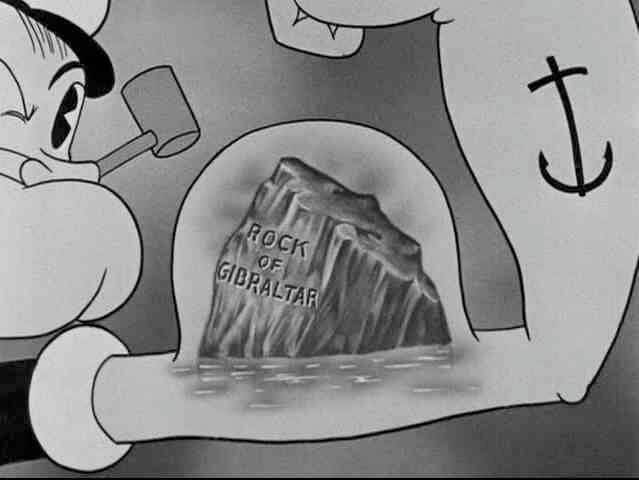
In that thumbnail, Popeye is flexing his arm and the Rock of Gibraltar appears on his bicep.
At first, I assumed that image was fan-made or edited by someone online. But I recently decided to investigate further. If the image actually appeared in the official cartoon, it could potentially represent another piece of reality residue connected to Gibraltar being an island.
The Source: A 1935 Popeye Cartoon
After looking into it, I discovered that the image does indeed appear in an official Popeye cartoon short titled:
Beware of Barnacle Bill
This was Popeye’s 18th theatrical cartoon short, released in 1935.
According to the cartoon’s description:
Barnacle Bill arrives at Olive Oyl’s home and begins fighting with Popeye over her. During the fight, Popeye eats a can of spinach and flexes his muscles, revealing an image of the Rock of Gibraltar on his bulging bicep before knocking Barnacle Bill away with a powerful punch.
Watch the Scene
You can watch the full cartoon below.
Pay close attention to the moment when Popeye eats spinach and flexes his arm.
What the Image Shows
When Popeye flexes his bicep, the Rock of Gibraltar appears on his arm.
If you look closely at the image, something interesting stands out:
The rock is shown standing alone and completely surrounded by water.
There is no visible land connection to Spain. Instead, the rock appears isolated in the sea, much like how many people remember Gibraltar—as an island.
Why This Could Be Reality Residue
If Gibraltar has always been a peninsula attached to Spain, then it raises an interesting question:
Why would animators in 1935 depict the Rock of Gibraltar as a landmass surrounded by water?
Cartoon artists often simplify geography, but they usually rely on commonly understood imagery when representing famous landmarks. In this case, the image resembles an island rather than a peninsula.
For those who remember Gibraltar as an island, this depiction could represent another example of reality residue—a leftover trace from a version of reality where Gibraltar existed differently from how it is presented today.
Another Layer to the Mystery
The fact that this image appeared in a 1935 theatrical cartoon places it decades before Gibraltar’s modern political history, including the border closure with Spain from 1969 to 1985 that is often cited as the reason Gibraltar was ‘like an island.’
Whether intentional or not, the image adds another curious layer to the growing list of references that depict Gibraltar in ways that do not perfectly match its current geography.
And sometimes, it’s the smallest details—hidden in old cartoons—that raise the biggest questions.