

Let’s talk about the International Island Games Association (IIGA) — the organizing body behind the Island Games, a kind of mini-Olympics for islands, an event that Gibraltar actively participates in.
According to Wikipedia, the Island Games are:
“A friendly biennial multi-sport competition between teams from several European islands and other small territories.”
The IIGA was formed in 1985, and Gibraltar became a member in 1987. Gibraltar has even hosted the Island Games twice, in 1995 and again in 2019. As of now, there are 24 participating members.
Here’s where things get interesting.
Wikipedia also states:
“Gibraltar is the only member of the IIGA that is not an island or group of islands, as it is a peninsula of Iberia, sharing a land border with Spain.”
I remember researching this back in 2018 and being genuinely surprised that Gibraltar was included at all. I went through every single Island Games member on Google Maps, checking their geography one by one. What Wikipedia states is true — every other participant is geographically an island.
At the time, I classified Gibraltar’s participation as reality residue of it being an island.
The obvious question is:
Why is Gibraltar participating in the Island Games if it isn’t an island?
Asking the Locals
During my investigative trip to Gibraltar in 2022, I began asking locals this exact question. To my surprise, most people didn’t know the answer. Many had never questioned it. Only a few could offer any explanation at all.
One of the few who did was Linda Alvarez, President of the Gibraltar Island Games Association.
In episode 18, Linda explains that politically and historically, Gibraltar has been “like an island.”
What Does “Politically Like an Island” Mean?
Before Gibraltar joined the Island Games in 1987, the border between Spain and Gibraltar was completely closed from 1969 to 1985.
This closure was ordered by Francisco Franco, Spain’s dictator at the time, as part of a long-running dispute over sovereignty. The border closure cut off all land access — no pedestrians, no vehicles, no trade. Gibraltar was physically isolated from Spain for 16 years, relying entirely on sea and air access.
Because of this isolation, Gibraltar functioned as if it were an island, despite technically being attached to Spain by a narrow isthmus.
This same explanation was officially used during the 6th Island Games in 1995, when Gibraltar hosted the event.
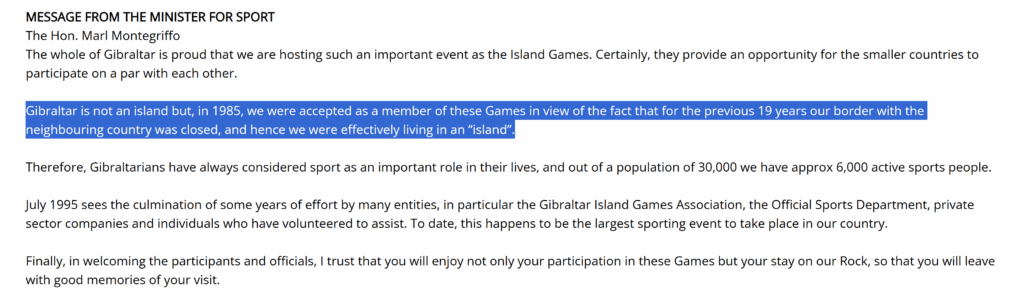
You can find this explanation directly on the IIGA’s official website.
Why This Explanation Still Falls Short
Even with this explanation, I remain unconvinced.
If Gibraltar’s participation were only about border closure, then why:
- Is Gibraltar the only non-island member?
- Why not rename the event “Small Territory Games” or “Island & Peninsula Games”?
- Why is Monaco, a small territory, not allowed to participate?
- Why does Gibraltar continue to participate long after the border reopened in 1985?
No matter how you frame it, the justification always circles back to the same phrase:
“Politically and historically, Gibraltar has been like an island.”
To me, that explanation isn’t the cause — it’s the leftover logic.
Island Games as Reality Residue
Gibraltar’s inclusion in the Island Games isn’t accidental. It isn’t just political convenience. It’s reality residue — lingering institutional memory from a hidden world in which Gibraltar actually exists as an island.
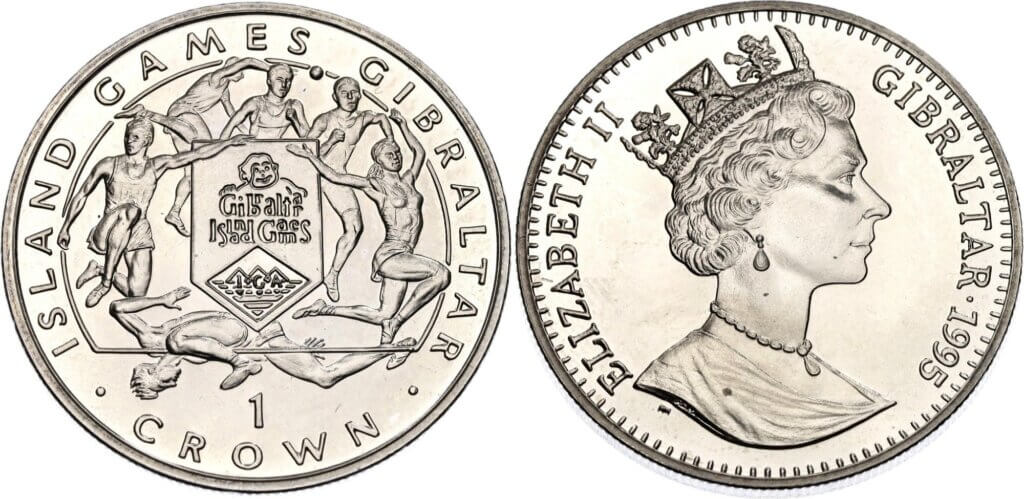
I’ve since collected extensive Island Games–related material connected to Gibraltar, which I consider physical evidence of this hidden world.
This collection includes Gibraltar Island Games:
- Coins
- Stamps
- Pins
These objects matter because institutions don’t casually misclassify geography on an international scale.
Final Thoughts
The real reason Gibraltar participates in — and has even hosted — the Island Games is not because it was once isolated.
It’s because it exists as an island in a hidden world that some of us remember and experienced.
The Island Games didn’t create this anomaly.
They preserved it.
And like so much else connected to Gibraltar, it’s another quiet reminder that something about this place doesn’t line up with the world we’re currently shown.