

At the Quest for Ancient Civilizations event in Sedona, Arizona, back in May of this year, Luke “Caverns” Reagan did an amazing presentation on one of the most mysterious civilizations of the ancient world: the Olmecs.
Luke is an anthropologist who specializes in Mesoamerica and has conducted expeditions and excursions throughout the Olmec heartland, continuing to investigate and shed light on a civilization that remains surrounded by enormous historical mysteries.
He titled his presentation “The Olmec Enigma,” a name inspired by a chapter of Graham Hancock’s 1995 book Fingerprints of the Gods.
I found Luke’s presentation fascinating, but one particular part immediately connected with something I have been researching for years: reality residue.
Watch Luke Cavern’s Presentation
Before I get into my own thoughts, I highly recommend watching Luke’s presentation in its entirety. His discussion provides important background on the Olmecs and explains why this civilization remains such an enigma.
After watching his presentation, there was one particular idea that stayed with me.
A Civilization With Almost No Formation Period
According to Luke, the Olmecs represent one of the clearest examples in the ancient world of a civilization that seems to emerge onto the archaeological record already fully developed.
The Olmecs are generally regarded as the earliest known major civilization of Mesoamerica, flourishing thousands of years before the Aztec Empire. Yet Luke points out just how little we actually know about the people who created this civilization.
We don’t know what the Olmecs called themselves. Their original language remains uncertain. We don’t have a complete understanding of their political system, religious beliefs, social structure, or how their civilization functioned on a day-to-day basis.
In many ways, we can see the Olmecs, but much of the context surrounding them is missing.
Luke explained that there are only a handful of examples throughout the ancient world where we encounter civilizations in such a state—where we can see the enormous monuments and achievements they left behind, but so much of the world that produced them remains unknown.
And then there is the question of how they got there in the first place.
Luke compared this with the development of monumental architecture in ancient Egypt. He discussed the argument that the Great Pyramids can appear to emerge relatively suddenly on the archaeological timeline, although there are archaeological developments and earlier structures that provide some evidence of progression.
But Luke argued that the Olmecs present an even more striking example.
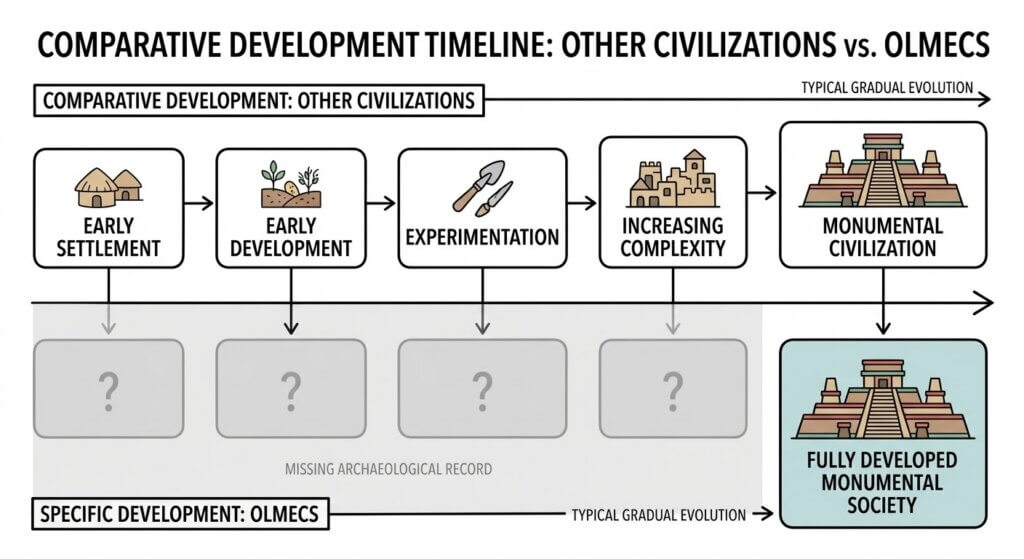
According to his interpretation of the archaeological record, there is no clearly documented period showing the Olmecs gradually learning how to produce the monumental works for which they are known.
Instead, they seem to arrive on the archaeological stage already capable of creating enormous monuments, sophisticated art, and colossal stone heads.
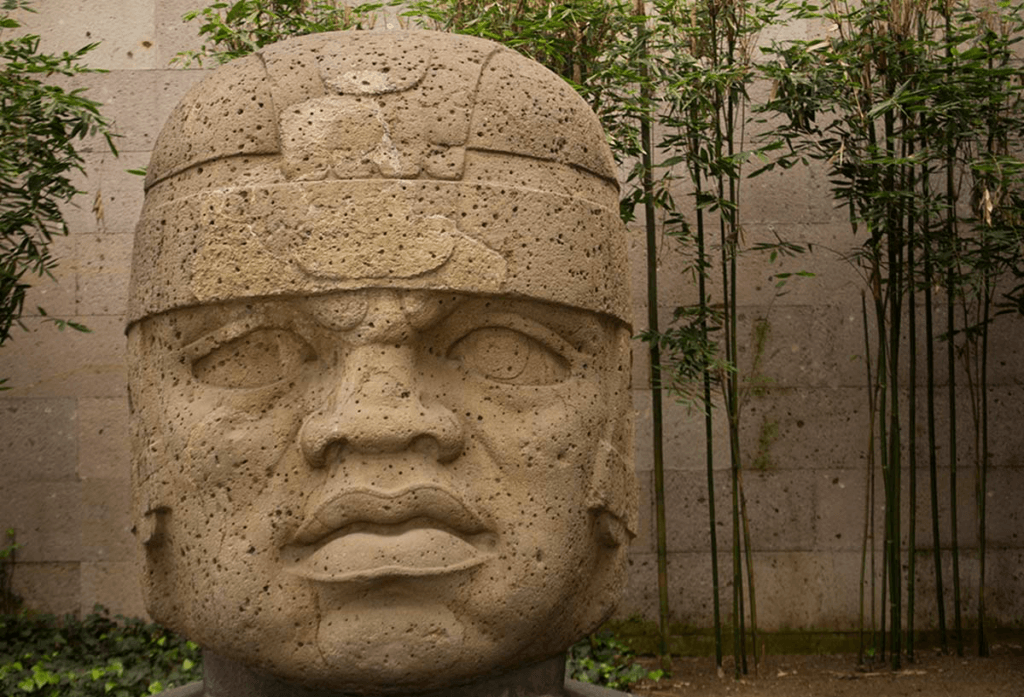
Luke described the Olmecs as perhaps the single strongest example in the ancient world of a civilization that seems to simply “appear.”
With other civilizations, we can often trace some sort of developmental sequence—a foundation, an early stage, a period of experimentation, and eventually an explosion of monumental construction.
But according to Luke, the Olmecs seem different.
There is no obvious shadowy preliminary period where we can watch them gradually develop the abilities necessary to create these enormous monuments.
They simply arrive.
And this is where my own research comes into the picture.
What Is Reality Residue?
During Luke’s presentation, I immediately began thinking about a term I have been using throughout my research into geographical Mandela Effects:
Reality residue.
If I were to define the term in dictionary form, I would describe it as:
Reality residue (noun) — Information, objects, images, memories, records, or other observable traces that appear to persist within a person’s perceived reality despite conflicting with what is currently accepted or presented as factual within that reality.
This concept is central to my research.
When I encounter something that seems to contradict the reality I currently experience, I don’t necessarily view that contradiction as an isolated mistake. Instead, I ask whether it could be a trace of something that exists differently.
This is particularly relevant to my research into geographical Mandela Effects, such as my investigation into the Island of Gibraltar.
A Different Way of Looking at Reality
In my previous article, “Hidden Worlds Within Our Reality: Decoding The World Map,” I explored my theory that what we perceive as a single reality may actually contain fragments of information from other versions of realities or other versions of this place we call Earth.
[LINK “Hidden Worlds Within Our Reality: Decoding The World Map” HERE]
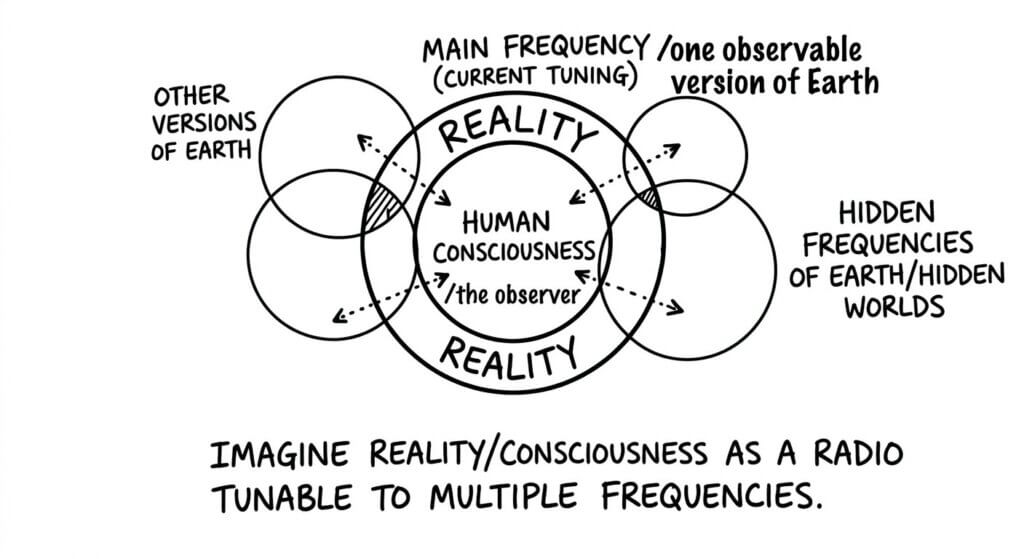
I often compare this concept to a radio.
Imagine that reality, or perhaps human consciousness, is like a radio capable of receiving multiple frequencies. What we experience as our reality is primarily the information coming through the one major frequency we are currently tuned into, while small fragments of information from other, hidden frequencies may also appear within it. In this case, those hidden frequencies could represent other versions of Earth—worlds with different geographies, histories, and circumstances.
Under this theory, the other frequencies—or hidden worlds—remain outside our normal perception.
Yet occasionally, small pieces of information from those worlds may appear within our current one.
Think of them almost like Easter eggs hidden in plain sight.
A photograph with a caption that describes something differently from what we see today.
A book with a title, passage, or description that contradicts what we understand to be true today.
A map that depicts geography differently from the geography we recognize and know to be true today.
A historical reference that describes a place, person, event, or circumstance differently from the accepted historical record.
A line in a song that seems to imply something different.
A geographical description that refers to a location in a way that doesn’t align with present-day geography.
A seemingly misplaced word or phrase that appears to contradict the information surrounding it.
Individually, any one of these things might be dismissed as a mistake, an error, a typo, or simply an unusual choice of wording. But when enough of these anomalies begin to accumulate around the same subject, I believe they can start to form a much larger picture.
This is what I mean by reality residue: small pieces of information from other versions of Earth that appear to linger in our current reality, even when they seem inconsistent with what we currently understand to be true.
The Olmecs as Reality Residue
Now return to what Luke said about the Olmecs.
A civilization appears on the archaeological timeline.
It appears already organized.
It appears capable of monumental construction.
It appears capable of creating enormous stone sculptures.
And yet the developmental story leading up to that civilization remains remarkably incomplete.
Luke’s description immediately reminded me of the way reality residue appears.
It is simply there.
We see the evidence, but the context surrounding it is missing.
This leads me to a completely different possibility.
What if the Olmecs did not originate within the version of reality we currently experience?
What if what we are seeing throughout Mesoamerica is actually reality residue from other versions of Earth?
Under this theory, the Olmecs would not necessarily be an isolated civilization that somehow appeared out of nowhere within our historical timeline.
Instead, we could be looking at fragments of an entirely different civilization whose world existed according to a different set of circumstances.
We are seeing information that is able to survive the transition between other realities or versions of Earth.
The monuments remain.
The colossal heads remain.
The archaeological sites remain.
But the broader context of the civilization is missing.
It’s almost as though we’re looking at fragments of a world without having full access to the world itself.
What Do I Mean by the “Mechanics” of Our World?
When I say that these civilizations may not have operated according to the same “mechanics” as our world, I’m referring to the fundamental conditions that define the reality we experience.
That could include things such as:
- The physical laws governing matter and energy
- Environmental and atmospheric conditions
- Geography and the configuration of land and oceans
- Biological characteristics
- Human physiology
- Available technologies
- Natural resources
- Historical circumstances
- The way civilizations develop and interact with their environments
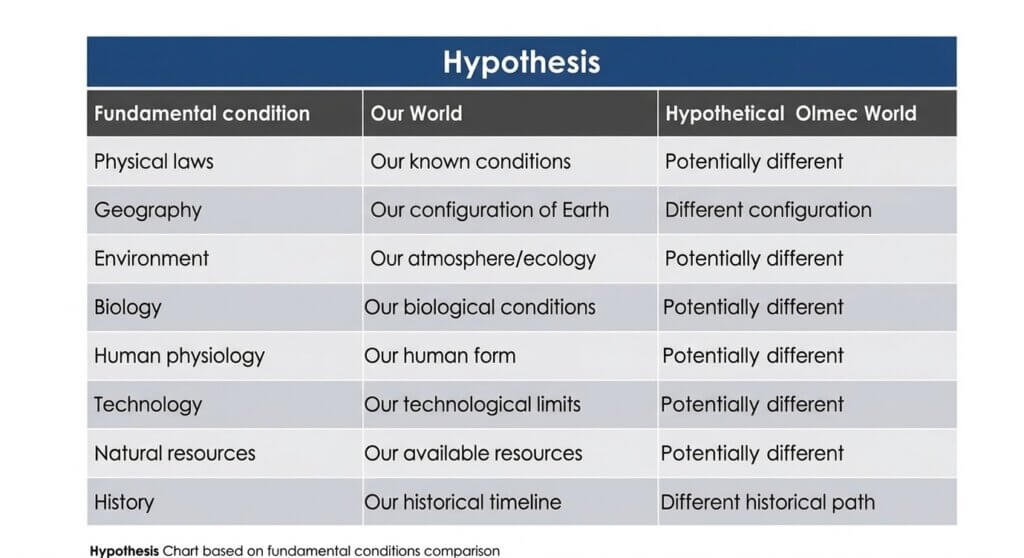
I’m not suggesting that I can demonstrate that these things are different in other worlds. Rather, this is part of the hypothesis I am exploring.
If another version of reality existed with different geographical, environmental, biological, technological, or historical conditions, then the civilizations living within it could potentially develop in ways that would seem inexplicable from our perspective.
This could provide one possible explanation for why some ancient civilizations appear so suddenly advanced.
Where Are the Olmec People?
This theory also raises another question.
If the Olmecs were a civilization that existed for centuries, where is the complete archaeological context of their civilization?
Where are all the ordinary traces of their daily lives?
Their tools.
Their personal belongings.
Their complete material culture.
Their remains.
Much of the archaeological record has undoubtedly been lost, destroyed, or simply not yet discovered. That is the conventional explanation, and it is important to acknowledge that archaeological evidence is often incomplete.
But my theory takes this in another direction.
Perhaps we are seeing only small pieces of the Olmec world that have somehow been able to bleed through and exist within our current reality and chronological timeline.
The monumental structures survive the bleed-through as physical traces.
Other parts of their civilization may not be able to.
Perhaps this is because the fundamental conditions that define the reality we experience don’t completely align with those of the Olmec world. To put this into perspective, imagine a Venn diagram.
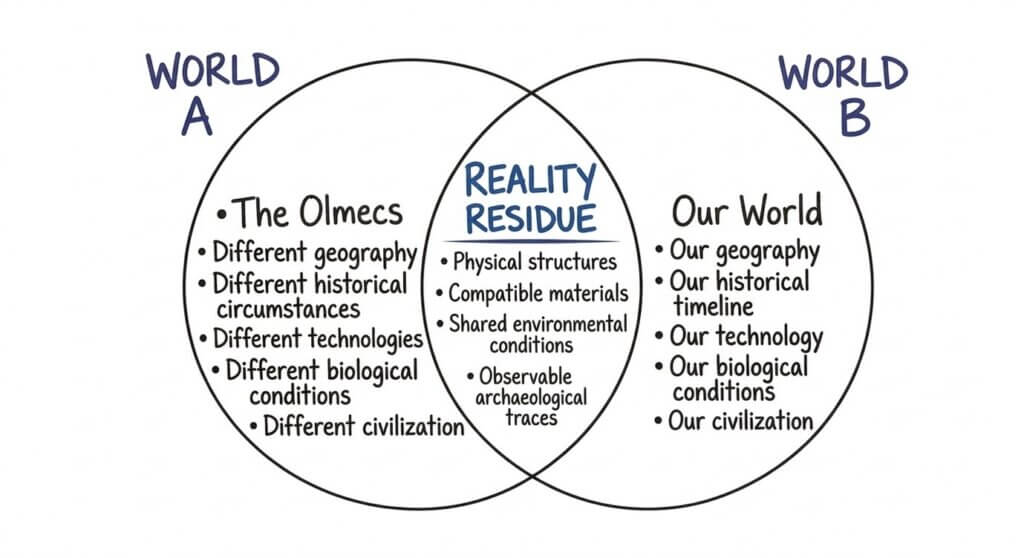
On the left is World A: the Olmec world.
On the right is World B: our world.
The area where the two circles overlap represents the point at which both worlds share certain traits, similarities, or fundamental elements. This overlap is where I believe reality residue can appear.
In other words, the remnants we can observe may exist within the intersection between these two worlds because they are compatible with certain fundamental conditions that both realities share.
Those conditions could include things such as physical laws, environmental conditions, geography, biology, or other underlying characteristics that allow something from one world to manifest or persist within another.
This could potentially explain why we might see the Olmecs’ monumental structures while not seeing everything else that would have existed within their civilization.
Their technologies.
Their tools.
Their everyday objects.
Their complete material culture.
Their biological remains.
Perhaps those things don’t exist within the overlap because the fundamental conditions governing their world don’t completely align with ours.
If the two realities were completely identical, there would be no meaningful distinction between them. And if they were completely incompatible, perhaps nothing from one could appear within the other.
But what if there is an intersection?
What if only certain things can cross that boundary because they share enough fundamental characteristics with both worlds to persist?
That would make the archaeological remains we see incredibly significant. They could represent the overlap between two realities rather than the entirety of the civilization from which they originated.
And if this model is possible, it raises another fascinating question:
Could people in the Olmec world—or other hidden worlds—also be seeing small fragments of our world within theirs?
Perhaps reality residue isn’t traveling in only one direction.
Perhaps both worlds contain traces of each.
Were the Olmecs Another Version of Humanity?
This idea takes me even further.
If hidden worlds exist with different geographical configurations and different versions of history, then perhaps they could also contain different versions of humanity.
This connects directly with another area of my research: human anatomical Mandela Effects.
I have previously documented claims from people who remember aspects of human anatomy differently from how they are presented today. I believe these memories deserve investigation as part of the broader Mandela Effect phenomenon.
Could ancient populations such as the Olmecs represent another version or design of humanity?
That is a much bigger question, and one I may explore in a future article.
For now, I want to stay focused on the observation that initially caught my attention:
Why does the Olmec civilization appear so fully formed out of nowhere?
The Olmec Enigma May Be Bigger Than We Think
Luke Caverns’s presentation left me thinking about the Olmecs in an entirely different way.
His description of a civilization that seemingly emerges without a clearly documented formation period immediately reminded me of what I have observed throughout my research into reality residue.
The information is there.
The structures are there.
The evidence is there.
But the context seems to be missing.
Perhaps the conventional archaeological explanation will eventually provide a complete picture of how the Olmecs developed. There is still much archaeological work being done, and new discoveries can change our understanding of ancient civilizations.
But I believe there is another possibility worth exploring.
What if some of these ancient civilizations aren’t simply lost civilizations from our own chronological timeline?
What if they are fragments of civilizations from worlds that we cannot normally perceive?
What if the reason some civilizations appear to suddenly arrive with extraordinary capabilities is because we are not actually seeing the worlds in which they exist in their entirety?
Maybe what we’re actually seeing are fragments of information coming from other versions of Earth.
Reality residue.
The Olmecs may be one of the most fascinating examples of this possibility.
And if that is true, then the Olmec mystery may not simply be about a lost civilization.
It may be about a truly lost world—in every sense of the word.