

In my previous article, “Invisible Barriers,” I wrote that if we can understand these invisible separations, we can begin to understand why different regions of the world have unique characteristics and distinct properties.
I want to expand on that idea here, using a real, living example that perfectly illustrates what I mean: the Barbary macaques of Gibraltar.
Europe’s Only Wild Monkeys
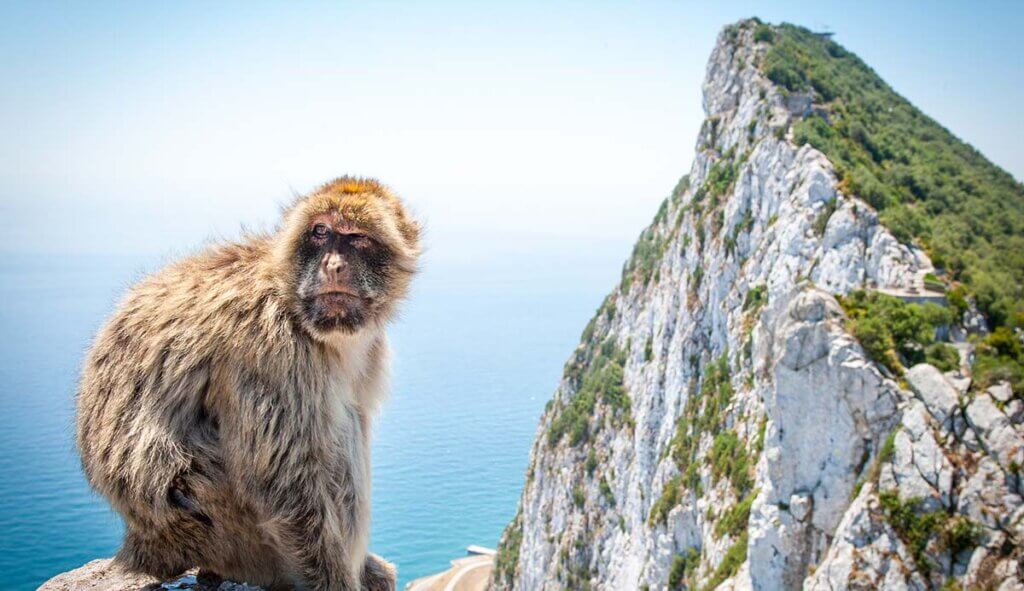
The Barbary macaques found on the Rock of Gibraltar are unique for one simple reason:
They are the only wild monkey population in all of Europe.
Outside of Gibraltar, these monkeys are found only in North Africa, specifically Morocco and Algeria. Now pause and think about how unusual that is. A wild monkey population isolated on a tiny piece of land at the southern tip of Europe, with no natural spread into the surrounding continent.
Naturally, this has led to several theories attempting to explain how the monkeys arrived in Gibraltar.
Theories — and What We Actually Know
Some of the commonly cited theories include:
- That the monkeys were brought to Gibraltar by the Moors between 700 and 1492 and kept as pets.
- That they are holdovers from a population that spread across southern Europe millions of years ago.
- That they traveled from Morocco through a subterranean tunnel beneath the Strait of Gibraltar, possibly via St. Michael’s Cave.
While these theories are interesting, the truth is this:
The only thing we know with certainty, based on historical writings, is that the monkeys were already present in Gibraltar before it became British in the early 1700s.
Everything else is speculation.
This means the Barbary macaques have been on Gibraltar for at least 300 years — wild, free-roaming, and established.
A Question That Doesn’t Add Up
Here’s where things stop making sense.
Gibraltar has always been connected to Spain in this reality by a narrow isthmus to the north. For centuries before modern infrastructure existed — before passport control, before the airport, before the horse racetrack that once occupied that land — the monkeys were already there.
They had every opportunity to wander north into Spain.
And yet, they never did.
For three centuries, these monkeys remained on the Rock.
That alone should raise serious questions.
Why didn’t they spread?
Why didn’t they migrate?
Why are they still confined to this exact piece of land?
A Land with an Invisible Boundary
The fact that the monkeys have remained exclusively on Gibraltar suggests that there is something more at play — something we can’t see.
An invisible barrier.
Just as Gibraltar itself exhibits political, geographical, and historical anomalies, the monkeys represent a biological anomaly tied to that same land.
The monkeys are a distinct property of Gibraltar.
They are in fact, in my view, reality residue of an island.
An Island in a Hidden World
The real reason the monkeys never left Gibraltar, I believe, is because Gibraltar is an island in a hidden world — a reality that some of us experienced and remember.
In that reality, the monkeys are unable to leave because the Rock is fully surrounded by water. They aren’t choosing to stay. They’re simply confined to the island.
This would also explain why the monkeys feel so deeply tied to Gibraltar itself, rather than the surrounding mainland of Spain.
Given everything I’ve researched about geographical Mandela Effects, I’m inclined to believe the monkeys were already there, even long before human intervention.
Could humans have brought them? Possibly.
But based on what we know about how land masses exist differently across hidden worlds, it’s far more plausible to me that the monkeys are native to this Rock, across realities.
Another Anomaly: Apes That Are Monkeys
During my visit to Gibraltar, I noticed something else that stood out.
The site where the monkeys can be seen is called Apes’ Den.
Yet officially, they are classified as monkeys.
This is strange for one key reason:
- Monkeys have tails
- Apes do not
The Barbary macaques of Gibraltar have no tails.
This makes them the only tailless monkeys in the world — another unique characteristic tied specifically to this location.
Calling the site Apes’ Den actually makes more sense anatomically than calling them monkeys at all.
Which raises another question:
Why are they classified as monkeys if they don’t have tails?
Bodies That Exist Differently Across Worlds
This observation brought me back to something I discussed in a previous article about Neanderthals and human anatomical Mandela Effects.
I believe these monkeys are no different.
Their bodies, like human bodies, are designed — and those designs can exist differently across hidden worlds.
My theory is this:
- In another reality, the Barbary macaques do have tails
- The classification as “monkeys” is reality residue from that world
- What we’re seeing now is a blend of information
This is, of course, a theory — but one that aligns perfectly with how reality residue behaves elsewhere.
Applying This Understanding Elsewhere
This is exactly what I meant by distinct properties and unique characteristics.
Once you recognize this pattern, you can apply it to other parts of the world.
Why do certain animals and plants exist only in specific places?
Why do islands like:
- The Galápagos (Ecuador)
- Socotra (Yemen)
Host life found nowhere else on Earth?
The standard explanation is evolution and isolation.
My explanation is different.
These lands exist within their own time and space.
The species didn’t migrate.
They didn’t evolve differently.
They belong there — because those places are not fully part of the same world as the surrounding land.
Once you understand invisible barriers and hidden worlds, these biological mysteries stop being mysteries at all.
They become evidence.