

As I mentioned in a previous post, the book Buried Alive by Jack Cuozzo discusses Neanderthals and notes that some of their remains were found on the island of Gibraltar.
Key word: island.
If you understand the concept of reality residue, then you’ll understand why this is not simply a geographical mistake. It isn’t a typo or an oversight. It’s information originating from a version of reality in which Gibraltar exists as an island — a hidden world we can’t physically see, but one that still exists.
That single detail led me to a much larger question:
How did Neanderthals arrive on the island of Gibraltar?
The Intelligence Problem
We are taught that Neanderthals were primitive — an earlier, less advanced version of humans. But that narrative immediately breaks down when you consider their presence on an island.
If Gibraltar was an island, then Neanderthals would have needed:
- The ability to build boats
- Understand direction, distance, and survival at sea
- The intelligence to traverse open water
Those are not the traits of a primitive species.
One common counterargument is that sea levels were much lower in the distant past, potentially creating a land bridge for them to travel across. I disagree with that explanation.
The simpler explanation is this:
Neanderthals were just as intelligent as modern Homo sapiens.
A Shared Intelligence, Not an Evolutionary Step
Most modern humans carry Neanderthal DNA. We’re taught that Homo sapiens migrated out of Africa and interbred with Neanderthals in Europe.
That alone contradicts the idea that Neanderthals were unintelligent.
If we could coexist with them — and even reproduce with them — then they were not an inferior or unfinished version of us.
I believe what we are actually looking at in Neanderthal fossils is a different human design, not a lesser one.
Are Humans Designed?
To explain this, we need to briefly touch on the Mandela Effect.
Many people — myself included — remember the human anatomy existing differently than it does currently. What’s striking is that people affected by the phenomenon often share the same anatomical memories, despite not knowing one another.
You can find evidence of these shared memories scattered across the internet. It’s a real and recurring pattern.
To me, these shared memories suggest something important:
The human body is designed.
And if it’s designed, then there is a designer.
That conclusion challenges the traditional theory of evolution. I also don’t believe our intelligence evolved from something less intelligent.
I don’t believe we were ever “stupider.”
Hidden Worlds and Human Variations
If human anatomy is designed, then multiple human designs can exist.
This opens the door to a possibility most people are never encouraged to consider:
that there are other versions of humans, existing in hidden worlds parallel to this one.
Neanderthals are one of those versions.
They were not primitive.
They were not a failed experiment.
They were not a stepping stone.
They were a parallel human design, possessing the same intelligence we do.
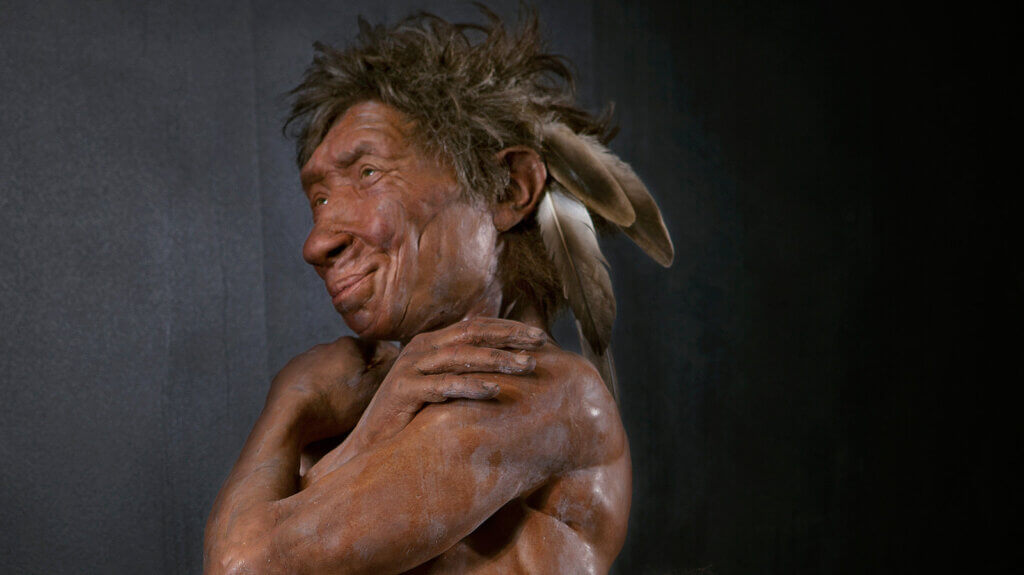
This also reframes depictions like “Nana” in Gibraltar, which portray Neanderthals as more ape-like and hairy — imagery that only makes sense if one assumes evolutionary inferiority as the starting point.
I believe that assumption is wrong.
The Gibraltar Connection Revisited
The oldest Neanderthal fossils found around the world are generally dated to roughly 300,000–400,000 years ago. Estimates vary, but the consensus places their existence across hundreds of thousands of years.
We’re also taught that Neanderthals mysteriously disappeared around 34,000 years ago.
And where is the last known evidence of their existence found?
Gibraltar.
Once again, Gibraltar sits at the center of a mystery that doesn’t quite add up.
I don’t believe Neanderthals disappeared.
I believe their fossils are reality residue — physical evidence of a human design that still exists in a hidden world we can’t currently see.
The fossils are not proof of extinction.
They are proof of parallel existence.
Coexistence Without Extinction
If you look into the oldest Homo sapiens remains ever found, you’ll see that the modern human design has existed for roughly 300,000 years.
That means modern humans and Neanderthals coexisted for hundreds of thousands of years.
We’re taught they lived alongside each other.
We’re taught they interbred.
Yet we’re also told Neanderthals vanished entirely.
That story doesn’t add up.
I don’t believe they vanished.
I believe they exist — just not here.
A Theory Worth Considering
Everything I’ve outlined here is theory. I’m not claiming it can be proven — at least not yet.
But I do believe it is the most logically consistent explanation when you consider:
- Geographical Mandela Effects
- Reality residue in books
- Gibraltar as an island
- Neanderthal intelligence
- Shared memories of anatomical differences
This is why it’s important to take the Mandela Effect seriously — especially geographical and perhaps anatomical Mandela Effects. They don’t just challenge maps or biology textbooks. They challenge our understanding of history, humanity, and reality itself.
So I’ll end where I began:
How did Neanderthals arrive on the island of Gibraltar?
I believe the answer is simple.
They arrived the same way we did —
because they were human, just a different design.
And Gibraltar was an island.