

In this post, I’ll be sharing an article published by The New York Times in July 2019, during the same period Gibraltar hosted the International Island Games. The article is titled:
“Gibraltar an Island? No, but Let the Games Begin”
Read it HERE.
This article stood out to me immediately because it confirms something I’ve been pointing out: even major media outlets find it strange that Gibraltar participates in — and hosts — the Island Games despite not being an island.
The Question With No Answer
One of the most important lines in the article reads:
“Local officials were unable to explain why it was considered an island only for that purpose. There was no definitive answer.”
Let that sink in.
This isn’t speculation from internet forums or fringe sources. This is The New York Times stating plainly that local officials could not explain why Gibraltar is treated as an island in this context.
I’ve written extensively about how Gibraltar’s participation in the Island Games is evidence — or reality residue — of a world in which Gibraltar exists as an island, and that article can be read HERE.
Presenting This Article in Gibraltar
What makes this even more significant is that I personally presented this exact New York Times article to Linda Alvarez, President of the Gibraltar Island Games Association, when I met with her to discuss this phenomenon.
Her explanation, like others I’ve heard, focused on Gibraltar being politically or historically “like an island.” But as the New York Times itself points out — there is no definitive answer.
The New York Times Facebook Post — An Even Bigger Clue
The New York Times didn’t stop at publishing the article. They also shared it on Facebook with the following caption:
“Gibraltar is not an island. So why did it spend the weekend inaugurating the International Island Games? One theory is that, simply, ‘most foreigners think that this is what Gibraltar is.’”
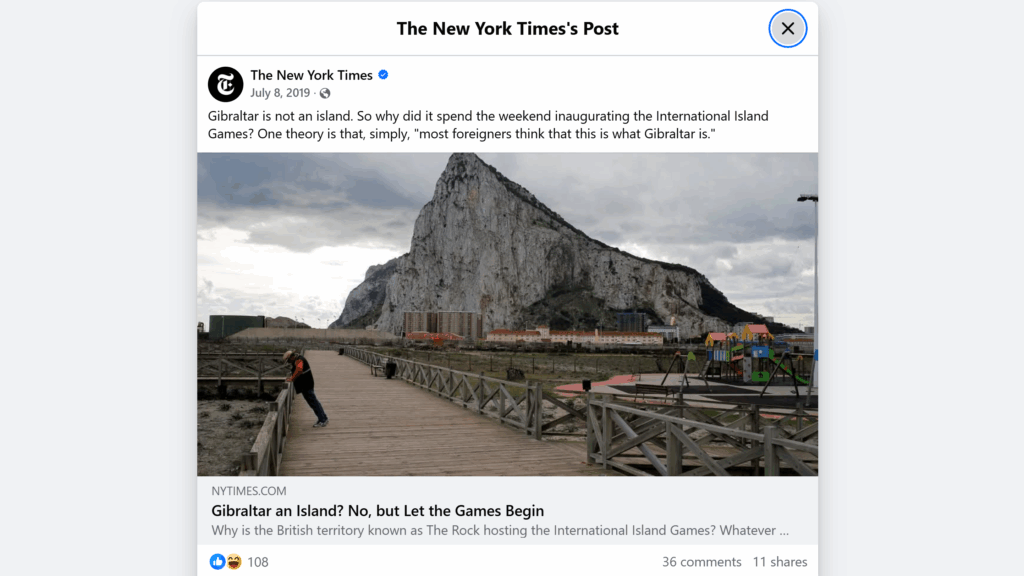
This is a critical moment — because the Times asks the right question but can only offer a theory, not an explanation.
Why “Foreigners” Are the Key
The article suggests that foreigners or tourists are the ones who think Gibraltar is an island. That actually makes perfect sense — once you understand how geographical Mandela effects operate.
After years of researching this phenomenon, I’ve noticed this consistent pattern:
- People who live in the location in question don’t see the geographical changes
- It’s only people outside the location — foreigners, visitors, tourists, outsiders — are the ones who have seen it, and remember it, differently
In other words, the people on the inside don’t experience the shift.
The people on the outside do.
That is exactly what we see here.
National Geographic Acknowledged This Too
What’s even more telling is that National Geographic acknowledged this same discrepancy in a post published in 2017, stating that many people think Gibraltar is an island.
Read it HERE.
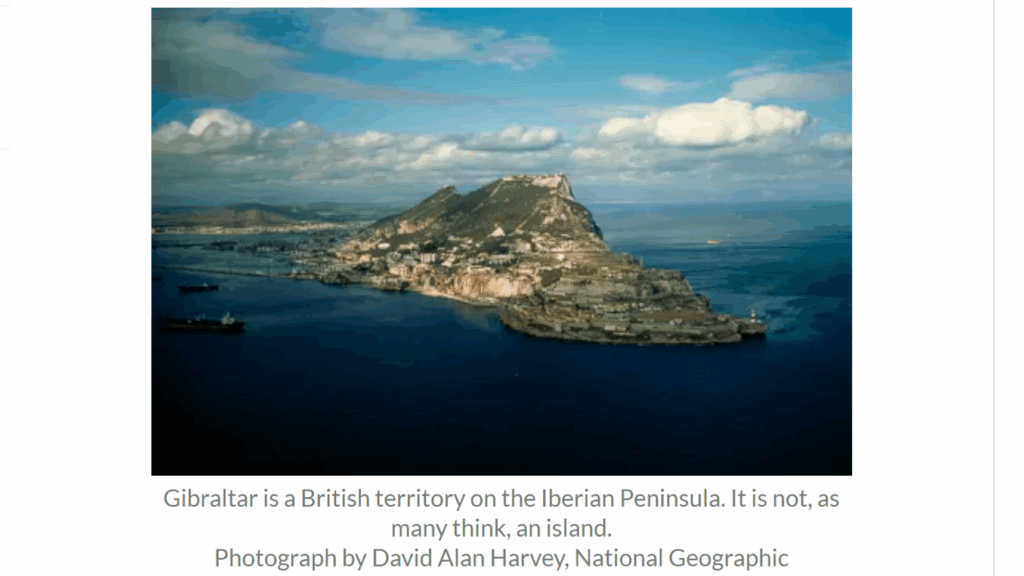
So now we’re not talking about obscure sources.
We have:
- The New York Times
- National Geographic
Both openly recognizing that there is widespread belief and confusion about Gibraltar being an island, even though current maps show it as a peninsula.
That isn’t coincidence.
A Discrepancy That Refuses to Go Away
When multiple reputable sources independently acknowledge the same contradiction — without being able to explain it — that tells us something important.
There is a reason:
- Gibraltar is the only non-island allowed to participate in the Island Games
- Even local officials can’t fully explain why
- Foreigners and tourists consistently remember it as an island
This isn’t just about semantics or political history.
This is reality residue — fragments of a world in which Gibraltar was an island, a world many of us experienced, even if we can’t physically see it anymore.
And when institutions like the New York Times and National Geographic quietly acknowledge the contradiction, it tells us we’re not imagining things.
There is more here than meets the eye.